"Free" Isn't Free: What Leaders Should Know Before Choosing an Open-Source AI Agent Platform
Intelligence
Malik Khan · · 4 min read
A wave of open-source alternatives to paid AI agent platforms has arrived, and many are advertised as free. The software is. Running it is not. Here is how to compare the real costs, licenses and risks, and the questions leaders should ask before saying "we can just run our own."
AI agents are becoming everyday tools. They can research, work with files, use connected apps and come back with finished work. Capability is becoming abundant, and that's exciting.
At PointClick, we use paid agent platforms heavily, including SpaceXAI's Grok Bot. On a personal level, I rely heavily on Muse from Meta for travel bookings and tracking business expenses on each trip. It has been a huge time saver: I no longer depend on someone else to do it, or do it myself.
Since Grok Bot launched in August, open-source alternatives such as OpenMausBot, Rakazo and OpenBot by CopilotKit have followed, alongside earlier projects like OpenClaw and Hermes Agent. They're impressive, and I'm glad they exist. But they're often advertised as “free,” and leaders deserve a fuller picture.
Disclosure: PointClick is a paying Grok Bot customer and uses it in our own operations. We have no commercial relationship with any of the open-source projects named here.
Free software is not a free operation
An agent platform is the harness: the software that connects a model to memory, tools, schedules and a chat interface. An open-source license can remove the platform's license fee. It doesn't remove the cost of doing work.
You still need intelligence, somewhere to run the platform, and someone responsible for keeping it healthy. Already paying for a laptop or cloud subscription may reduce the incremental hosting bill, but it doesn't make capacity or staff time unlimited.
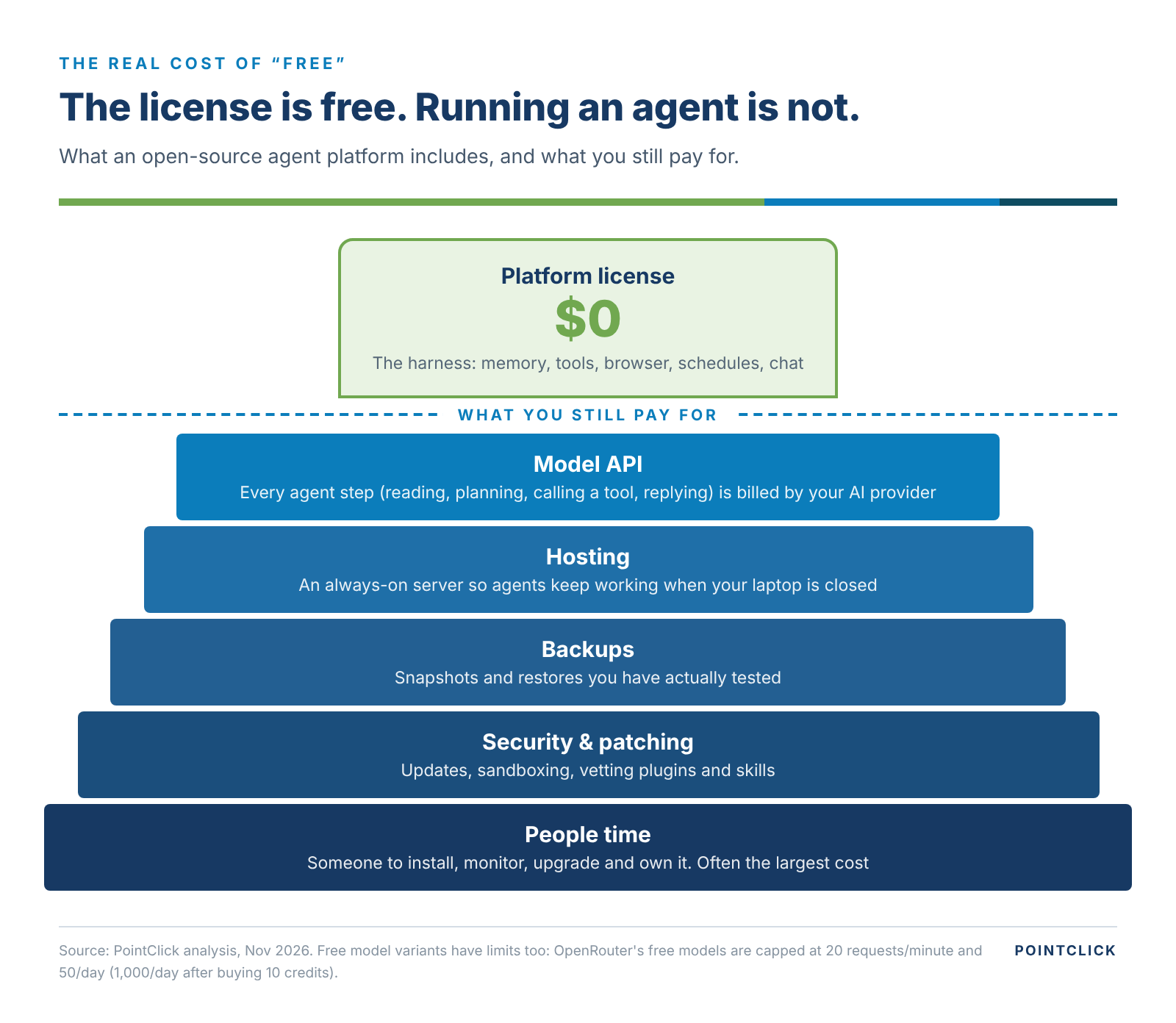
Every step an agent takes is billed by the AI provider you connect, whether that's OpenAI, Anthropic, Google, xAI or another. The projects say so themselves: Rakazo notes there is no seat fee and “you pay the model provider you connect.”
Free models, for example through OpenRouter, are great for experimenting. But they come with rate limits, and smaller models often have shorter context windows and weaker reasoning for complex, multi-step work. The right question isn't “is it free?” It's “is it good enough for the job, reliably?” Running open models on your own GPU servers gives the most independence, but it's a significant investment.
Compare total cost, not the subscription sticker
The chart below illustrates one person using an agent for business tasks. “Light,” “moderate” and “heavy” are assumptions, not measured customer workloads. All token totals are across a task's steps, not a single prompt.
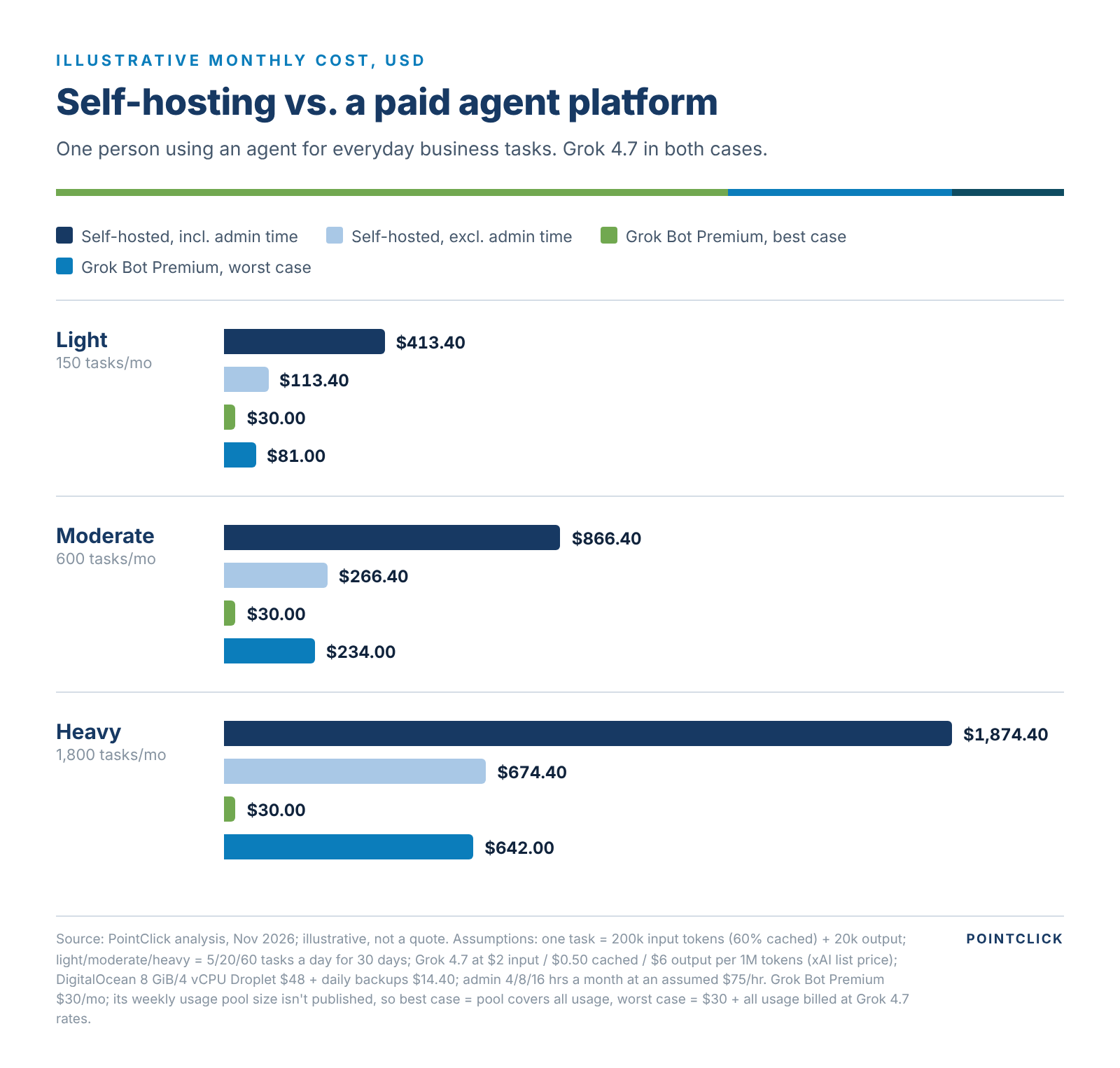
Premium is listed at $30 a month with Grok Bot included. Its weekly pool size isn't published as a token allowance, so we cannot say how many of these tasks it would cover. The two paid-platform cases are scenarios, not a guaranteed bill range. They assume the same Grok 4.7 token mix and rates as the self-hosted example, not verified identical behavior inside Grok Bot.
Administration uses an assumed $75 an hour and four, eight or sixteen hours a month. Substitute your own figures. Both options still need permissions, human oversight and output review; those common costs are excluded.
The takeaway: the model bill grows with work on either path, and admin time is what tips the balance. A cheaper model can cut token costs sharply, but test quality before you optimize for price.
Open source is a choice, not one product
The options below differ in interface, deployment, model support and operating burden. GitHub stars are an interest signal, not a security certification or a count of business customers.
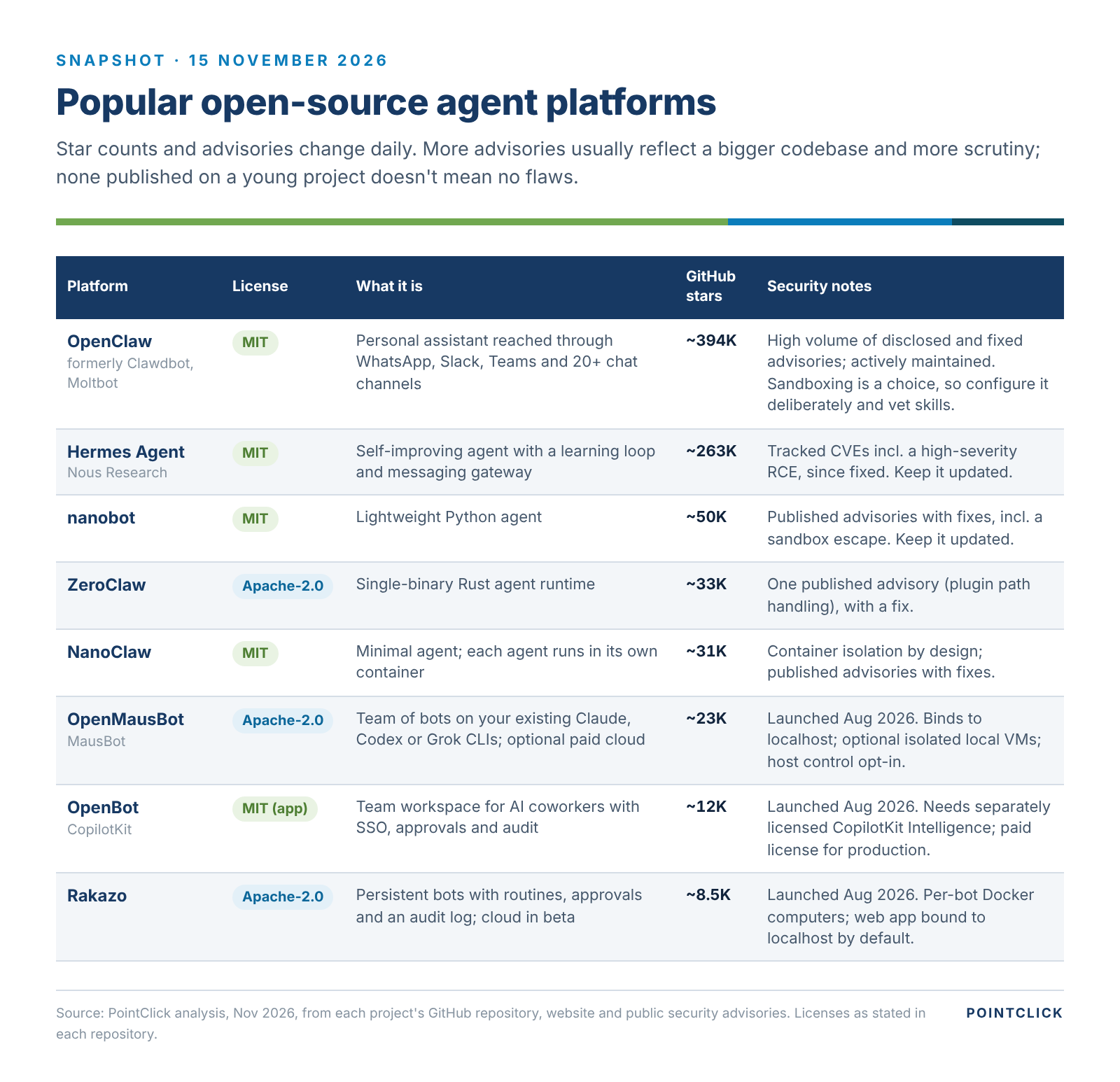
OpenClaw's popularity has brought scrutiny, disclosures and fixes. Other projects also publish advisories and patched versions. A project with no published advisories isn't necessarily safer. Check maintenance, supported releases, authentication, sandboxing and how quickly your team can apply updates.
Also read beyond the repository license. OpenBot's application template is MIT-licensed, but its required CopilotKit Intelligence service has separate terms. Self-hosted does not automatically mean every component is free.
Read the license before building on it
The rights to modify, redistribute or offer software as a service matter to a business. So do the terms of required services, plugins and model weights. Open-core is a business model, not a single license; examine the terms for each component.
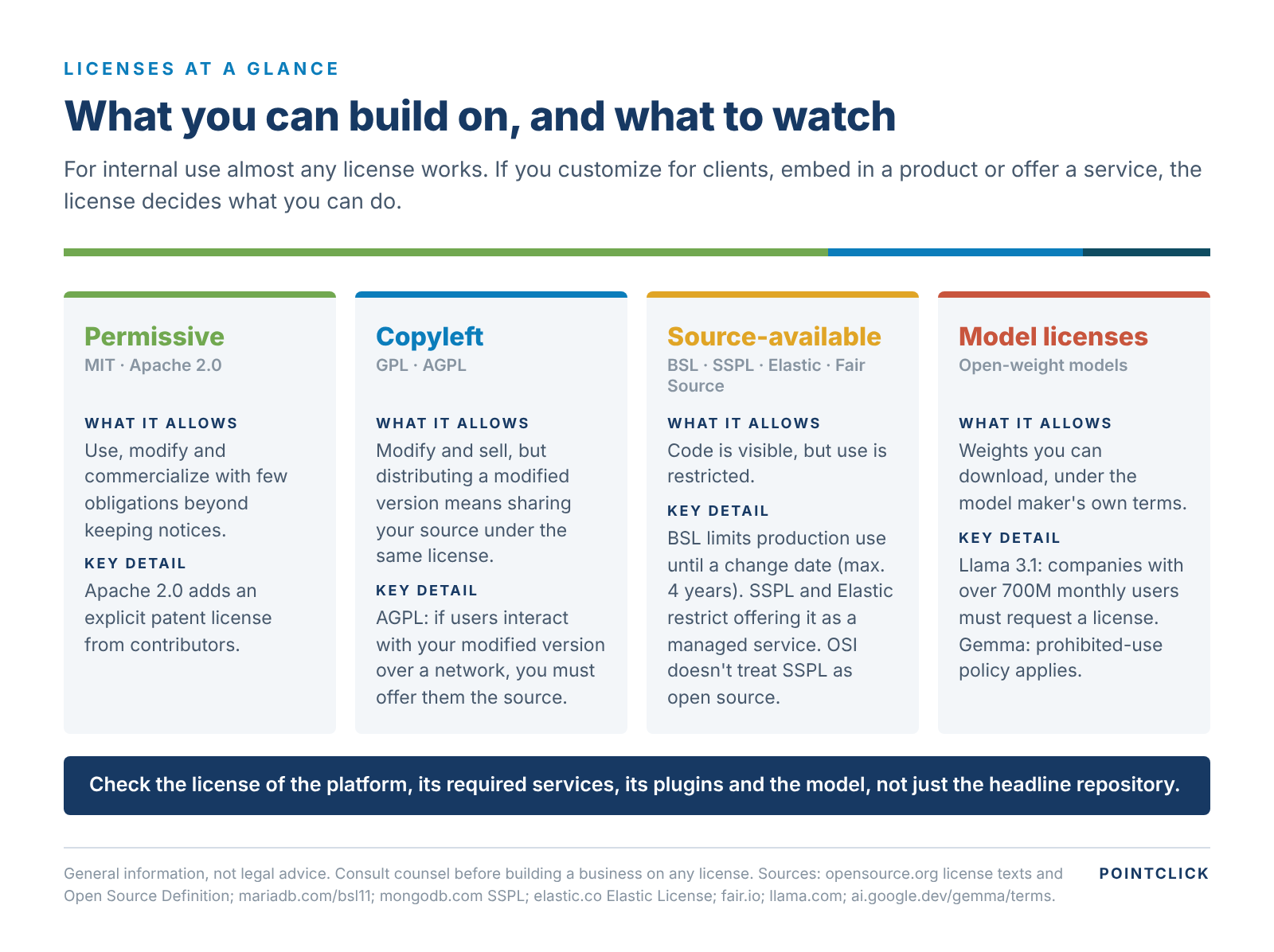
This is general information, not legal advice. Ask counsel to review the actual licenses and your intended deployment.
Why we're evaluating open source internally
I'll be candid: we're evaluating open-source agent platforms ourselves, for internal use only. Not mainly for cost, but for freedom.
We want to customize the platform for our own use cases and be able to change and own the code. We also don't want our internal operations to depend solely on one vendor's release schedule.
Our approach is to run in parallel. Grok Bot stays. Alongside it, we're assessing a customized open-source platform for internal work where control justifies the extra responsibility. This is not a plan to abandon a useful paid tool.
Independence brings responsibility
As we discussed in our Microsoft 365 outage article, no single service should be treated as if it cannot fail.
Self-hosting can give you control over the agent environment and backups. It doesn't make a cloud model local: prompts still go to whichever provider you connect. Sovereignty requires examining the whole data path, not just the server's location. Hosting your own model is another option, with its own hardware, capability and operational trade-offs.
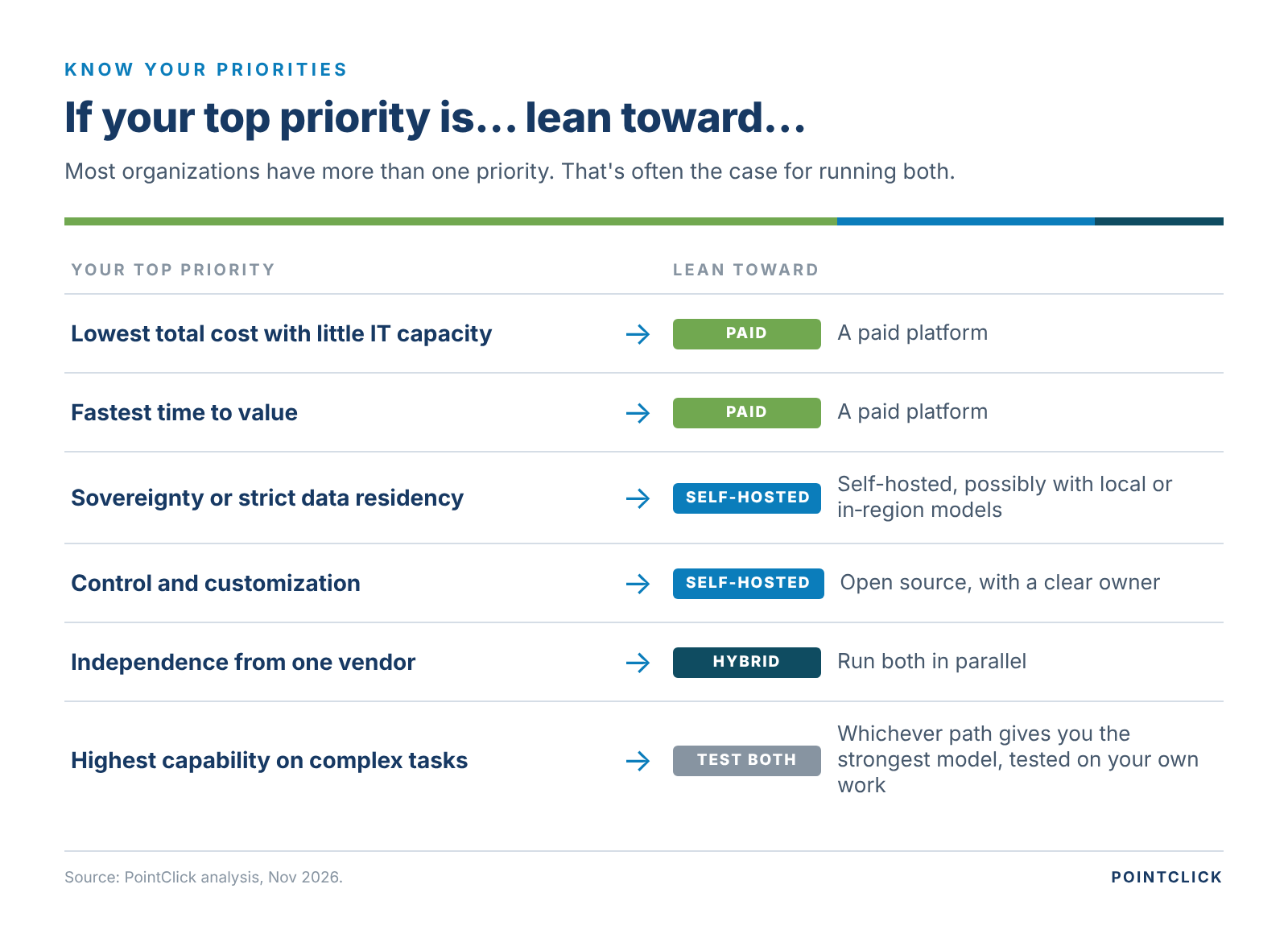
This is the ownership point behind the PointClick Enterprise Intelligence Framework (PCEIF): someone must remain accountable for how AI is governed and operated. Taking control means taking responsibility, not removing it.
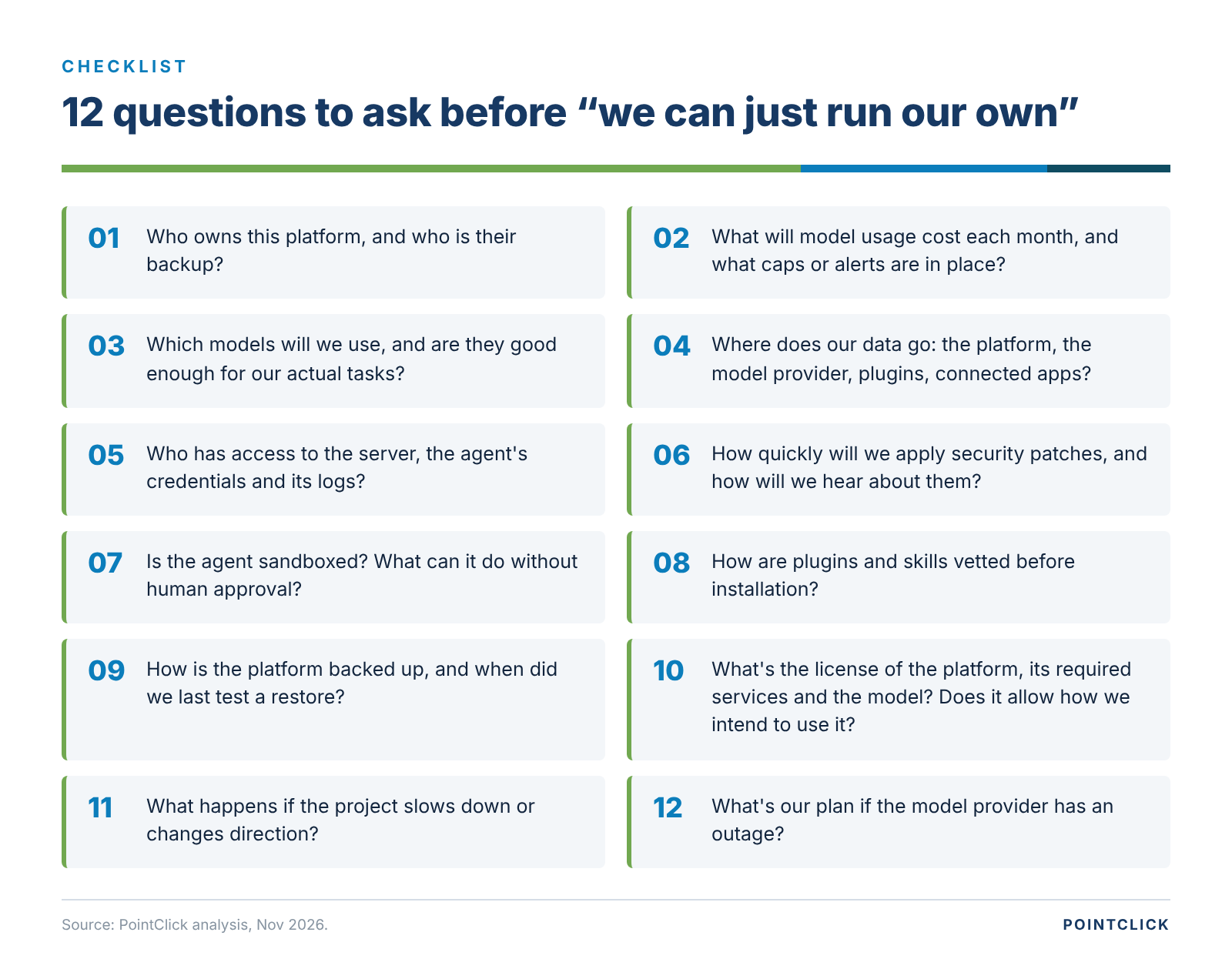
Choosing is now a leadership skill
Don't choose solely because a platform is free. Choose for the outcomes, freedom and responsibilities your organization is ready to own. Start with a bounded task, compare results and costs, and pick the right partners.
PointClick can help assess the options, true costs and risks. Contact us at support [at] pointclick [dot] net or through our contact page.
Malik Khan is Founder and CEO of PointClick Technologies, a managed IT and cloud services provider founded in 2007 with offices in Raleigh, Málaga, Banjul and India.
AI Agents Open Source Total Cost of Ownership Digital Sovereignty AI Governance Vendor Lock-In Software Licensing