Bubble or Not, the Bill Is Real: What Anthropic's S-1 Tells Leaders About the Economics of AI
Intelligence
Malik Khan · · 8 min read
A company that didn't exist six years ago has filed to go public at a valuation reported in the trillions. I read the S-1 to separate the froth from the demand, and to work out what it means for how leaders plan, buy and build with AI.
In January 2021, Anthropic was incorporated in Delaware. On 26 October 2026, not yet six years later, it filed its S-1 with the SEC to list on Nasdaq under the ticker “ANT.”
I’ve run PointClick since 2007, through the cloud shift and the mobile wave. I have never seen numbers like these.
You’ve probably heard the headline: a $2 trillion valuation. First lesson for any leader: that number isn’t in the S-1. The filing leaves the price range blank. After Anthropic’s investor day in mid-October, Reuters reported that some investors were pushing for about $1.5 trillion instead.
So separate two things that get blurred: what the market says AI companies are worth, and what customers actually pay for. The S-1 shows the second.
What the filing actually says
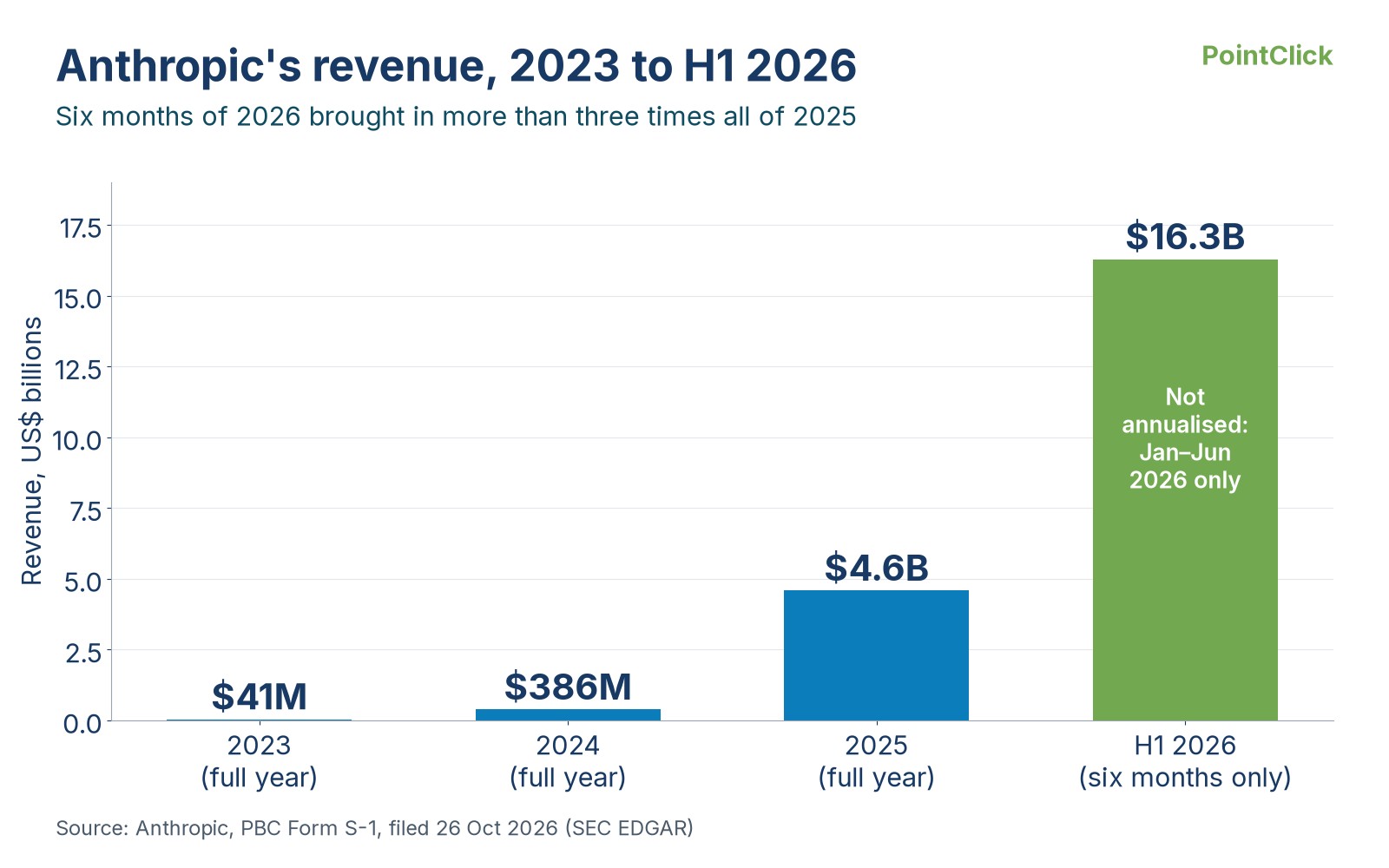
Anthropic earned $41 million in 2023, $386 million in 2024 and $4.6 billion in 2025. In the first six months of 2026 it earned $16.3 billion. At its investor day, the company reported $16.8 billion for the third quarter.
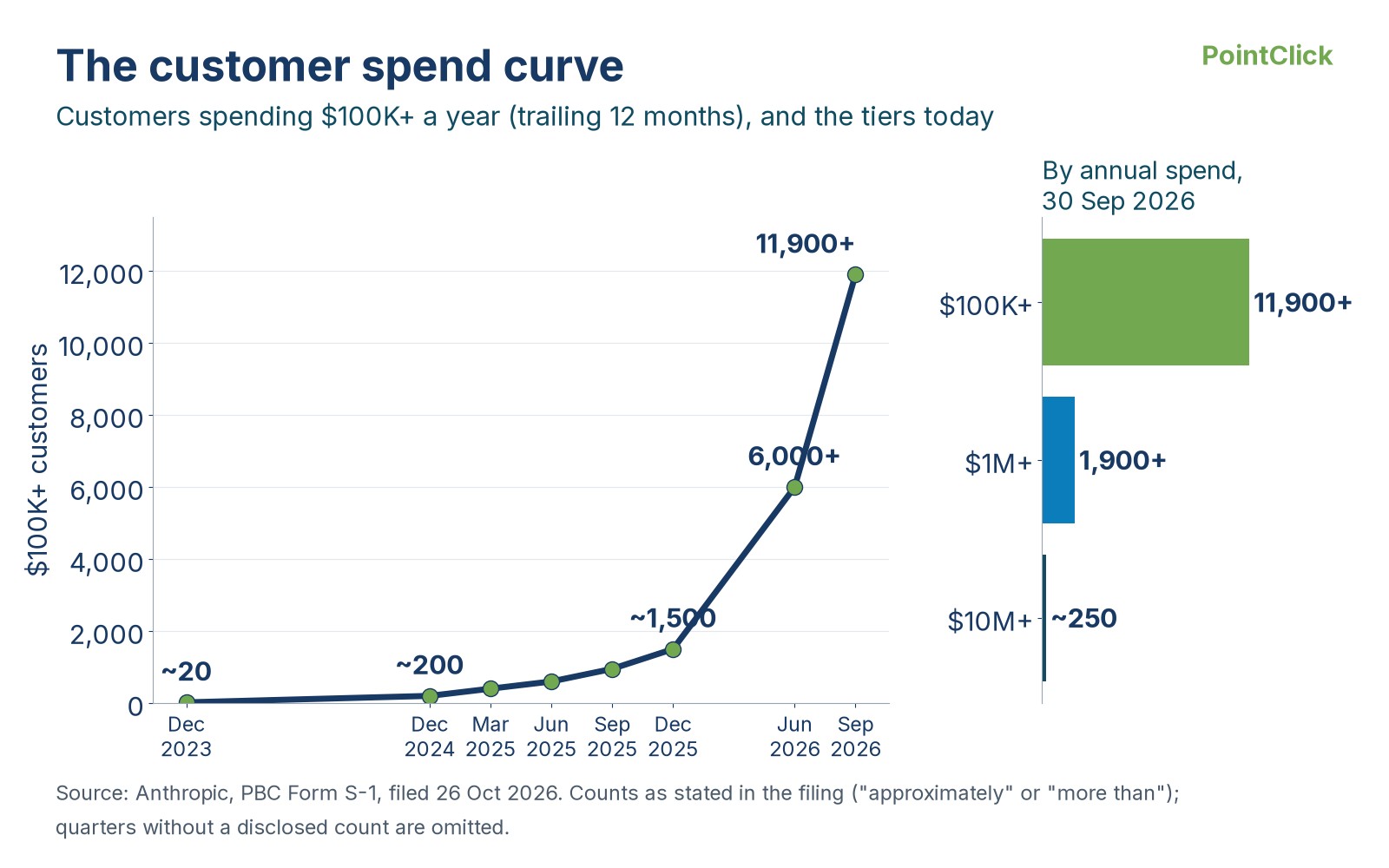
This isn’t experimentation. As of 30 September, more than 11,900 customers spent at least $100,000 a year with Anthropic, up from about 1,500 at the end of 2025 and about 20 at the end of 2023. More than 1,900 spent over $1 million, and about 250 over $10 million. Net revenue retention was about 900%: existing customers, as a group, spent roughly nine times what they did a year earlier.
Margins are turning too. The operating margin went from -249% in the first quarter of 2025 to +8% in the second quarter of 2026. Most of the $80.7 billion first-half net loss is a non-cash charge on convertible notes.
Two more details matter. The filing says Claude Opus 5.5 cut customers’ cost per task by about 40% compared with Opus 5, and cheaper work drove more work. And for its Fortune 500 customers spending $100,000 or more, Anthropic’s revenue averaged less than 0.1% of their total expenses in the third quarter. Big companies have barely started.
The other side of the ledger
In the first half of 2026, Anthropic spent $8.9 billion on compute and infrastructure, about 55 cents of every revenue dollar. And it has committed to far more. The S-1 describes agreements to spend at least $44.9 billion with Microsoft, about $114.5 billion with Google and $110 billion with Amazon, each “regardless of actual usage.” On top of that are deals worth up to $120.5 billion with SpaceXAI, more than $20 billion with AMD, and more.
By my arithmetic, the three hyperscaler agreements alone total about $269 billion in minimums, for a company that earned $4.6 billion last year. Costs land before revenue. Anthropic warns that margins “may compress” and that growth “may decline significantly.”
The whole industry is placing the same bet. Microsoft, Alphabet, Amazon and Meta are guiding to roughly $720 to $745 billion of capital spending in 2026, and CNBC reports the group is expected to top $1 trillion next year.
SpaceX: the other trillion-dollar AI story
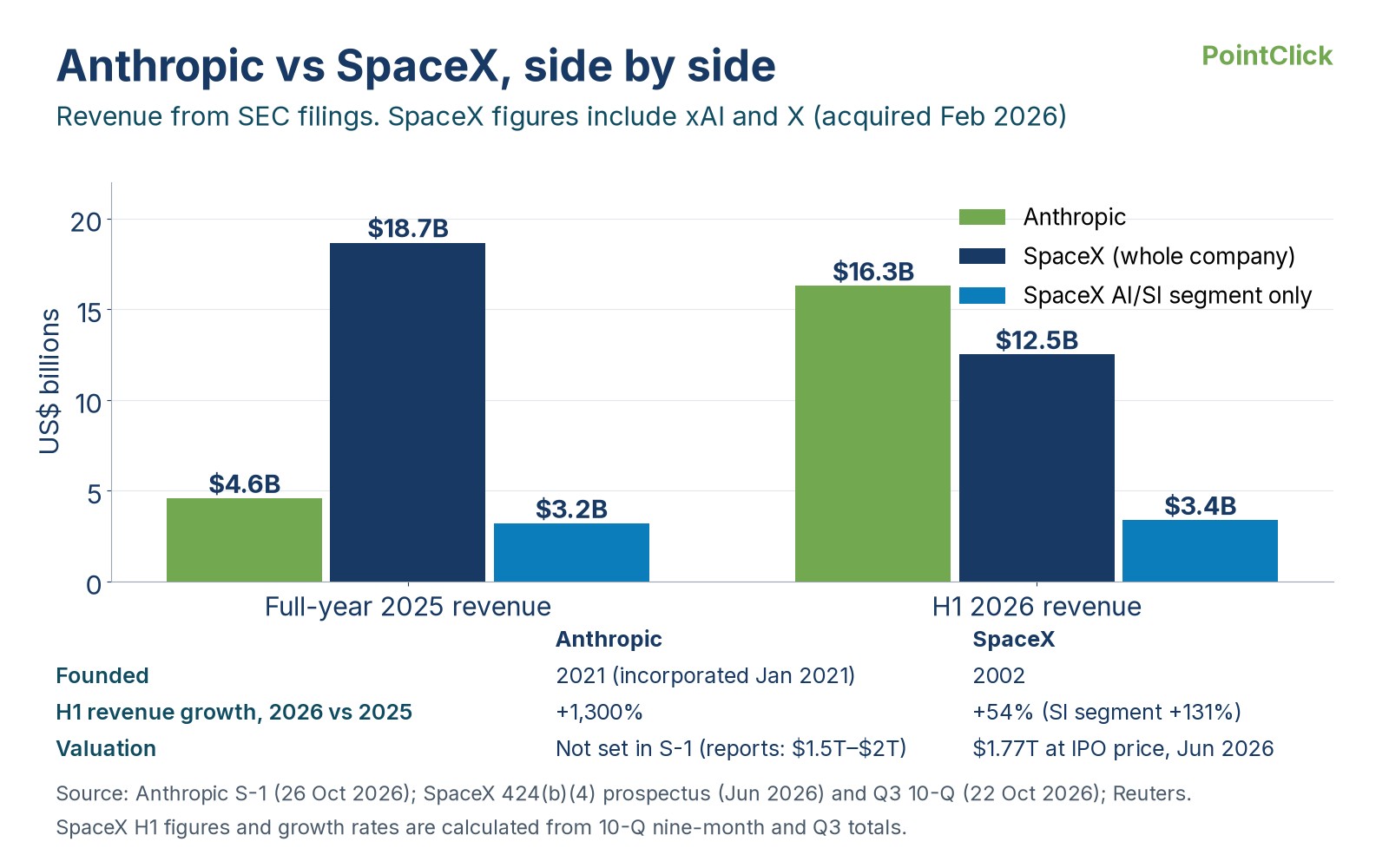
The best comparison for Anthropic is SpaceX, which priced the largest US IPO on record in June, raising about $75 billion at a valuation of about $1.77 trillion. It is now an AI company too. In February it merged with xAI. The unit became SpaceXAI in July and, after Elon Musk said he would rename it, now appears in its own legal terms as SpaceX Super Intelligence, or SpaceXSI.
Then came the ecosystem. In June SpaceX agreed to buy Anysphere, maker of the Cursor coding tool, in an all-stock deal valued at $60 billion; it closed in August. Days earlier, SpaceXAI launched Grok Bot, always-on AI agents that work across your apps, and extended it to Cursor and SuperGrok plans.
The results show in SpaceX’s third-quarter 10-Q. Revenue in its Super Intelligence segment rose 830% to $7.6 billion, and the segment swung from a $1.7 billion operating loss to a $431 million profit. Cursor contributed $608 million between its mid-August close and 30 September. Installed compute nearly tripled to 1.7 gigawatts.
Here is the twist: much of that growth is compute sold to other labs. SpaceX’s prospectus says Anthropic pays it $1.25 billion a month through May 2029, and a single unnamed customer in that segment produced 34.5% of SpaceX’s total third-quarter revenue. One lab’s compute bill is another’s AI revenue. Either side can end that deal on 90 days’ notice.
So, is it a bubble?
My answer is yes and no. Britain’s 1840s railway mania ruined investors and left a network that carried the economy for a century. The late-1990s fibre boom left the cable that later carried the cloud. Financial froth and durable demand can exist at the same time.
What makes me cautious:
- Circular money. Many companies selling compute to AI labs also invest in them. A Bank for International Settlements working paper models the race pushing investment to about 1.5 times the efficient level, and LSEG compares it to late-1990s telecom vendor financing.
- Chips that age fast. Researchers at Georgetown argue AI chips may have a useful economic life of one to three years, while many firms depreciate them over five or six.
- A demand treadmill. Anthropic says models released in the previous six months produced over 80% of its third-quarter revenue. Staying at the frontier costs a fortune.
What tells me the demand is real:
- The unit economics are improving. In the second quarter, revenue was up 1,368% on a year earlier, while compute and infrastructure costs were up 300%.
- Penetration is barely started. Less than 0.1% of a large company’s expenses is a beginning, not a peak.
My position: valuations may be ahead of themselves; the demand isn’t. Some investors will get hurt. But the capability is real and getting cheaper per task. Leaders shouldn’t plan around whether the bubble pops. They should plan around the fact that the capability stays.
What to expect from OpenAI
OpenAI is the obvious next listing. It confidentially filed in June, and Bloomberg reports a listing has slipped to at least next year, with annualized revenue of about $50 billion at the end of September. Note that Anthropic and OpenAI count cloud-resold sales differently, so run-rates don’t compare cleanly.
When its prospectus is public, I’ll read three things: consumer versus enterprise revenue; the compute bill, given reports of $278 billion in expected cash burn from 2026 to 2030; and whether infrastructure keeps pace. A planned expansion of its Stargate campus in Abilene, Texas, was dropped this year, partly because the power wouldn’t be ready in time.
The real constraint is electricity
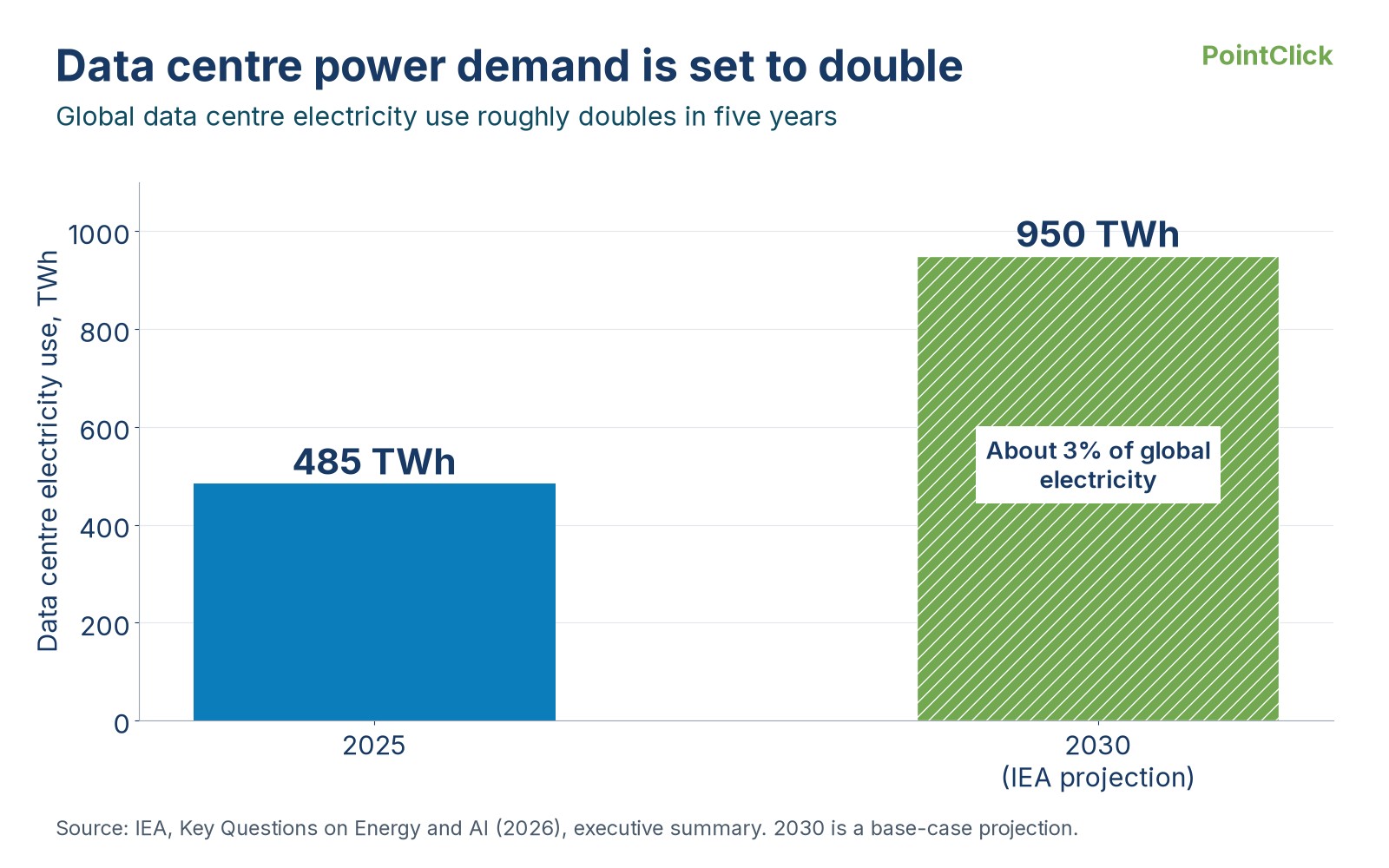
The IEA expects data center electricity use to roughly double from 485 TWh in 2025 to about 950 TWh in 2030, around 3% of global demand. In the US, the IEA projects data centers will account for almost half of electricity demand growth to 2030. A Lawrence Berkeley National Laboratory report for the US Department of Energy estimates they could use 6.7% to 12% of all US electricity by 2028, up from 4.4% in 2023.
Anthropic’s own S-1 calls power “a significant constraint” and notes its public commitment to cover electricity price increases its data centers cause for consumers. Energy is now part of the AI business model. Across Raleigh, Málaga, Banjul and India, we see how different power, connectivity and data rules can be. Where your AI runs is a strategic question, not an IT detail.
How leaders should read the signals
- Don’t bet the company on the valuation. Bet on the cost curve. Cost per task tells you more than any share price. When work gets 40% cheaper in one generation, last year’s “not yet” may pay now.
- Design for portability. Anthropic runs on four chip families rather than depend on one supplier. Do the same with models: keep your data, prompts, evaluations and workflows in a form you own.
- Budget for volatility. AI is mostly priced by consumption, and suppliers carry huge fixed commitments. Prices could fall sharply, or rise if capacity tightens. Set usage limits and watch spend weekly.
- Measure value per task, not usage. Tokens are a cost. Hours returned and errors prevented are value. If you can’t name the value, you’re funding someone else’s growth.
- Use the next 12 months well. Pick three workflows where AI can do finished work, each with a named owner. Run each through our free AI Responsibility Scorecard before you scale it. Train people to manage AI work, not just use AI tools.
What we see on the ground at PointClick
These numbers aren’t abstract to us. At PointClick we are avid Grok Bot users, and we are steadily becoming dependent on it and on the agents we run, as I showed in my article on superpowers. Our Grok Bot spend has at times been over $3,000 a week.
That is the S-1’s story in miniature: when the work is worth handing over, usage grows and spend follows value. It’s also why we watch spend weekly. Usage-based AI grows as fast as you let it, so the question isn’t “what did it cost?” but “what did it return?”
Six years old: what this says about opportunity
The most important fact in the S-1 may be the company’s age. A business founded in 2021 counts more than half of the Fortune 500 among its six-figure customers. The barrier to building something significant has collapsed, and when anyone can build almost anything, judgment becomes the scarce resource.
- AI services for the mid-market. Anthropic has launched a services company with private equity partners to bring Claude to mid-sized firms. Adoption is limited by implementation, not intelligence. That’s the work of managed intelligence: connecting models to real data, workflows and accountability.
- Agent operations. As AI moves from answering questions to doing hours of work, someone must supervise, audit and fix it. It’s a new discipline, as managed IT was 20 years ago.
- Foresight products. As I wrote in The Real Promise of AI Isn’t Intelligence. It’s Foresight., the richest prize is systems that see trouble coming, and cheaper reasoning puts that within reach of smaller organizations.
- Leapfrog markets. Much of Africa leapt past landlines to mobile. Some emerging markets may leap to AI-delivered expertise, if power and connectivity are there.
The capability stays
Bubbles are about prices. Revolutions are about capabilities. This filing shows both. If the market corrects, the capability will still be there, probably cheaper. The leaders who win won’t be the ones who guessed the valuation. They’ll be the ones who used this window to build the judgment, ownership and data discipline to turn cheap intelligence into advantage.
Don’t wait for the market to tell you whether AI is real. Pick the three workflows that matter most, score them, and then let’s talk about how to build them to last.
Economics of AI AI Strategy AI Adoption AI Agents SpaceX Grok Bot Data Centers Energy Leadership